Automated monitoring and quantitative analysis of feeding behaviour in Drosophila
Itskov PM, Moreira JM, Vinnik E, Lopes G, Safarik S, Dickinson MH, Ribeiro C
Quantify food consumption in individual Drosophila with single-sip resolution. No dyes, no manual scoring, no observer bias.
The flyPAD measures food intake by detecting capacitance changes each time a fly extends its proboscis to interact with food. Two electrodes — one beneath the fly and one embedded in the food substrate — form a sensor that registers individual sips at 100 Hz.
Each sip event is timestamped and logged automatically. Total food intake is calculated from the cumulative number and duration of sip events over the experimental period, providing a precise, dye-free quantification of consumption.
Data acquisition runs through the open-source Bonsai framework, enabling real-time monitoring of feeding activity across up to 96 channels per unit.
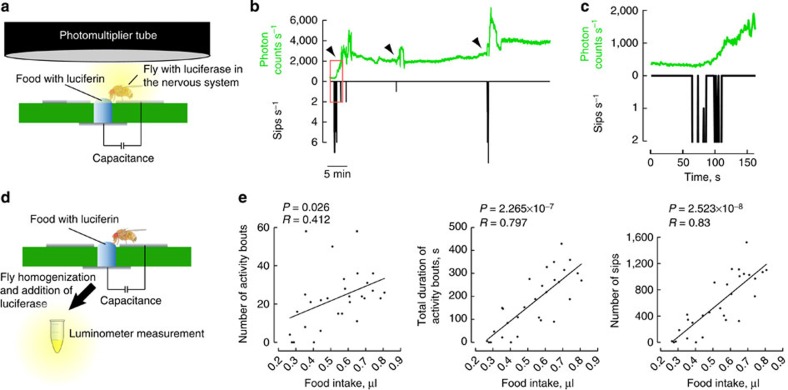
Food intake can be approximated by two flyPAD-derived metrics: the total number of sips and the total duration of activity bouts. Both are extracted automatically from the capacitance signal — no dyes and no weighing.
In the original flyPAD study, these metrics were calibrated against a direct, real-time measure of ingestion. Flies expressing luciferase in the nervous system fed on a 10% sucrose solution containing luciferin, while a photomultiplier tube recorded the light emitted as food was ingested. Across flies (n = 29), both the number of sips (R = 0.83) and the total duration of activity bouts (R = 0.80) correlated strongly with the independently measured ingested volume — roughly 1 nl consumed per sip. (The number of activity bouts alone is a much weaker proxy, R = 0.41.)
The same approach was independently validated in mosquitoes. In Aedes aegypti females feeding on sugar and on blood, both the number of sips and the number of activity bouts positively correlated with the volume ingested (measured with a fluorescent tracer), with activity bouts giving the strongest correlation (Spearman ρ ≈ 0.53–0.55). See Henriques-Santos et al., Scientific Reports (2023).
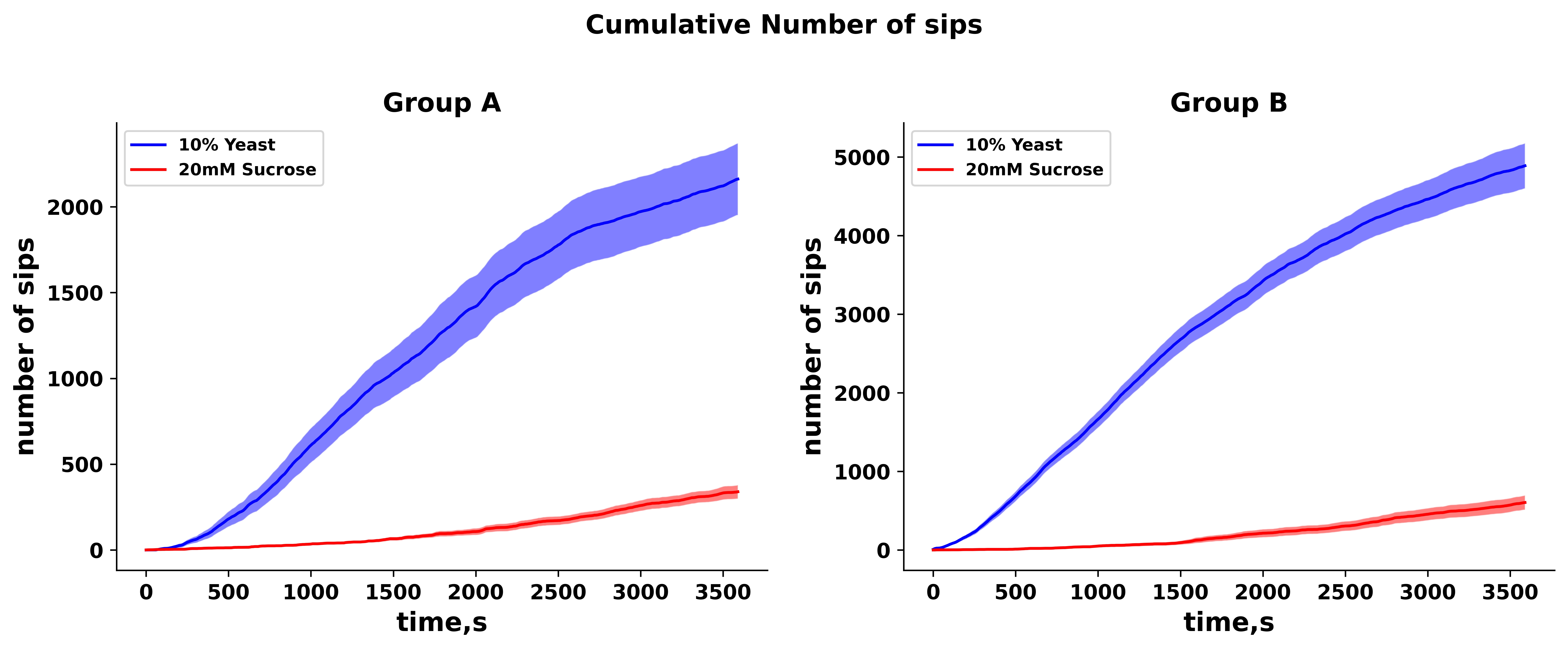
Cumulative food intake over time, measured automatically by the flyPAD.
Example output generated automatically by the flyPAD analysis software. See the full sample analysis →
The flyPAD captures detailed food intake parameters from individual flies.
Cumulative number of proboscis-food interactions per fly over the assay duration.
Duration of each individual feeding event, measured with millisecond precision.
Aggregate time spent interacting with food across the entire experiment.
Sips per minute across different time windows for temporal analysis.
Time elapsed before the fly begins feeding, a measure of motivation.
Distinct feeding episodes separated by inactivity periods.
Standard 96-channel feeding monitor. High-throughput food intake measurement with single-sip resolution.
Adds closed-loop optogenetics to the flyPAD — drive or suppress food intake by activating specific neurons the moment the fly feeds.
Tailored arena designs for non-standard food types, substrates, or organism sizes.
Itskov PM, Moreira JM, Vinnik E, Lopes G, Safarik S, Dickinson MH, Ribeiro C
Get a quote for the flyPAD system configured for your food intake experiments.